iWild Casino Volatility in Slots describes how a slot’s wins are distributed, including how often they land and how large they tend to be—not how much the game pays back overall.
This guide explains every volatility level with real examples, clears up volatility versus RTP, and offers a practical way to match a slot’s risk pattern to your bankroll, playing goals, and comfort with winning swings.
What Is Slot Volatility?
Slot volatility, also called variance, describes the balance between win frequency and win size. Lower-volatility games usually deliver more frequent wins that tend to be smaller, while higher-volatility games produce rarer wins that can be considerably larger.
Volatility is programmed into a game by its developer. It does not change from one session to another, and the same game does not become more or less volatile depending on the machine or player.
Two slots can share the same RTP while feeling completely different. The difference comes from how each game distributes its theoretical return over time.
Slot Volatility at a Glance
Low volatility trades win size for win frequency. High volatility trades win frequency for win size. Most slots sit somewhere between these extremes, forming a spectrum rather than fitting one perfectly fixed label.
How Slot Volatility Affects Your Gameplay
Volatility is easiest to understand by considering what a game feels like at the reels. High-volatility slots can produce long stretches without a meaningful win, or returns smaller than the original bet, followed by an occasional large payout.
Low-volatility slots usually create a steadier rhythm of smaller wins. They may extend a playing session but rarely produce one dramatic result.
Neither experience is automatically better. Low volatility may suit smaller bankrolls and relaxed sessions, while high volatility may appeal to players comfortable with greater risk and longer dry spells.
Volatility Levels Explained
Volatility is commonly simplified into low, medium, and high levels. However, some providers now promote slots at more extreme ends of the spectrum.
The following sections explain each tier using real, named games and their commonly published specifications.
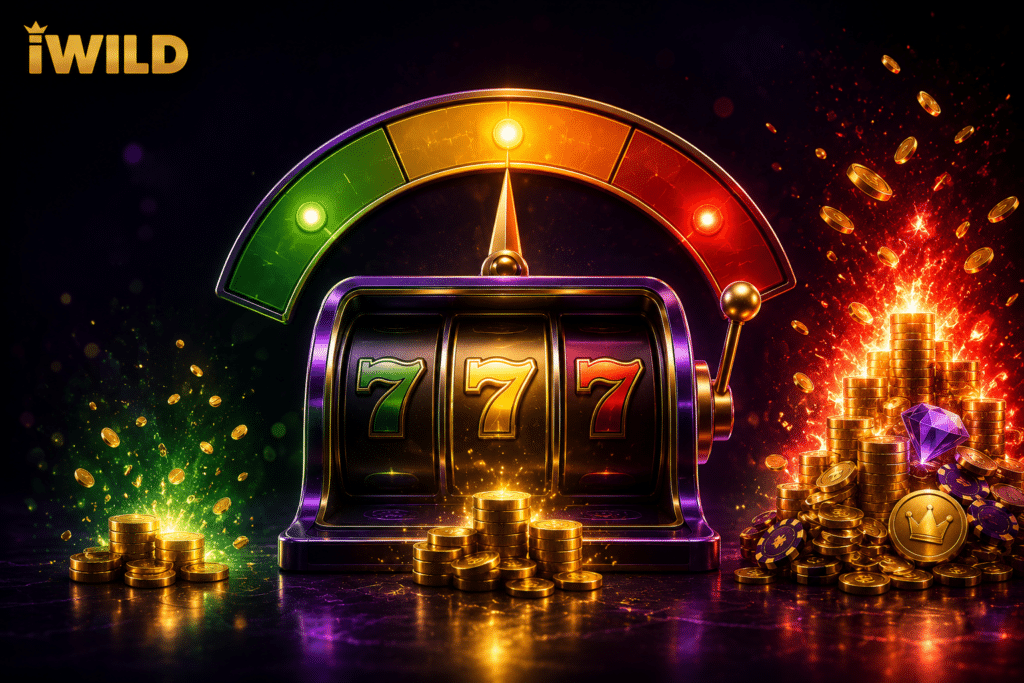
Low Volatility Slots
Low-volatility slots generally produce frequent, smaller wins. They can suit casual players, smaller budgets, and people who prefer longer, more relaxed sessions with less dramatic balance movement.
A well-known example is Starburst by NetEnt. It has an RTP of approximately 96.1%, a 10,247x maximum win, and is commonly classified as low volatility. Its simple design, expanding wilds, and frequent smaller payouts helped make it widely recognised.
Low volatility does not mean no risk or guaranteed profit. It simply means the game tends to create smaller, more frequent swings instead of rare and dramatic ones.
Medium Volatility Slots
Medium-volatility slots aim to balance win frequency and payout size. They may provide regular smaller wins while also offering occasional payouts that feel more substantial.
Cleopatra by IGT is a long-standing example, with an RTP commonly listed at around 95.02%, a 45x maximum win, and a medium-to-low volatility profile depending on the version. Its free-spin feature can increase excitement without creating the extreme dry spells associated with some high-volatility titles.
This tier can suit players seeking more excitement than a low-volatility game offers, without fully committing to high-volatility losing stretches.
High Volatility Slots
High-volatility slots produce wins less frequently, but successful combinations can deliver substantially larger payouts. They appeal to players comfortable with extended losing stretches in exchange for greater potential win sizes.
Book of Dead by Play’n GO is a widely played example. It is commonly listed with a 96.21% RTP, a 5,000x maximum win, and high volatility. Its expanding-symbol free spins can create significant payouts, but qualifying for a strong bonus result is not guaranteed.
High volatility is also common among newer releases, making it useful to understand even if you do not actively seek this style of game.
Extreme and Insane Volatility — The Tiers Beyond High
Extreme and insane volatility are genuine industry terms, not simply marketing language. Developer Nolimit City helped popularise these classifications for games that sit beyond standard high volatility.
Extreme-volatility slots typically offer even rarer wins and a higher potential payout ceiling. Insane volatility is marketed as the most intense tier, where many individual spins return less than the original bet in exchange for an occasional exceptionally large win.
These games are designed for experienced players who understand substantial bankroll swings. They are generally unsuitable for beginners or anyone uncomfortable with long losing sequences.
Best Low and High Volatility Slots to Try
Explore low- and high-volatility games in demo mode before playing for real money. Low-volatility titles offer steadier, lower-pressure sessions, while high-volatility games provide a taste of larger swings. Check each game’s current details on iWild Casino, as RTP, volatility, and maximum-win figures can vary by version.
| Game | Provider | Volatility | RTP | Max Win | Notes |
| Starburst | NetEnt | Low | 96.09% | 250x | Frequent smaller wins and simple expanding-wild |
| Gonzo’s Quest | NetEnt | Medium | 96.00% | 2,500x | Balanced gameplay with avalanche wins and free falls |
| Book of Dead | Play’n GO | High | 96.21% | 5,000x | Less frequent wins with strong free-spin potential |
| San Quentin xWays | Nolimit City | Extreme | 96.10% | 150,000x | Highly volatile mechanics with substantial potential swings. |
| Mental | Nolimit City | Insane | 96.10% | 100,000x | Extreme variance designed for experienced players. |
Slot Volatility vs RTP — What’s the Difference?
Volatility and RTP measure two completely different things. They are not directly linked, so one figure cannot be used to predict the other.
RTP, or return to player, is the theoretical long-term percentage a slot returns over a very large number of spins. Volatility describes how that return is distributed across individual sessions and payouts.
A slot can have a high RTP and low volatility, or a high RTP and high volatility. The two figures tell you nothing about each other.
Worked Example — Two Slots, Same RTP, Different Volatility
Imagine two hypothetical slots, both with a 96% RTP.
Slot A has low volatility and delivers frequent wins worth roughly 2x or 3x the bet. Its balance may move gradually during a session.
Slot B has high volatility and may produce 50 or more spins without a win before landing one payout worth several thousand times the bet.
Over a very large number of spins, both slots theoretically return 96% to players. However, a real session on either game can feel and look completely different.
How to Find a Slot’s Volatility Rating
Volatility is not always clearly labelled, particularly on physical slot machines. Knowing where to look can help.
The most reliable methods include checking the paytable, researching the game online, or asking casino staff when playing in person.

Check the Paytable
A game’s paytable can often suggest its volatility, even when no rating is displayed. Many modest payouts and relatively few high-value combinations generally indicate lower volatility.
A dramatic gap between common small wins and rare, extremely large prizes usually points toward higher volatility.
This method can work on online games and physical machines that provide no explicit volatility information.
Research the Game Online
Most reputable slot-review websites, player forums, and developer pages state a game’s volatility rating directly. A quick search can therefore be the fastest way to confirm the information.
This is especially useful online, where game details are usually more transparent than in physical casinos. Always compare information from reliable, current sources.
Ask Casino Staff
At a physical casino, staff may be able to suggest machines commonly associated with higher or lower volatility based on experience.
This is a practical fallback when the machine provides no rating and you cannot research the game immediately. However, staff may not have access to exact volatility figures.
Volatility in Online vs Physical Slot Machines
A game’s volatility does not change between its online and physical versions when the underlying game is identical. The developer programs the same mathematical model regardless of where the slot is played.
The main difference is transparency. Online platforms often display volatility in the information panel, while physical machines may show no rating.
That makes paytable analysis and online research especially useful in land-based casinos.
he Impact of Volatility on Gameplay
Volatility affects more than win frequency and payout size. It can shape the entertainment value of a session, your bankroll requirements, and the behaviour of bonus features.
Entertainment Value
Low-volatility games generally suit relaxed sessions with steady activity and frequent smaller outcomes. They may feel consistent without creating dramatic changes in your balance.
High-volatility games create more suspense. Long dry spells can build anticipation, followed by the possibility of a much larger win.
Neither style is automatically more entertaining. The better choice depends on whether you want a calmer session or a more intense, high-risk experience.
Bankroll Strategy
Low-volatility games are generally more forgiving for smaller budgets because losses may occur more gradually and smaller wins can appear more often.
High-volatility games usually require a larger bankroll. You need enough funds to withstand extended losing stretches without running out before a significant payout has a chance to land.
No bankroll can guarantee a win, so set a firm spending limit before playing.
Bonus Rounds and Jackpots
Volatility often affects bonus features and jackpots, not just the base game. Low-volatility slots may trigger bonuses more frequently, but their features often have lower overall win potential.
High-volatility games may make bonuses harder to trigger, while offering significantly larger rewards when they do appear.
The same general pattern can apply to jackpots, multipliers, and free-spin rounds, so check each game’s rules before playing.
Choosing the Right Volatility Level for You
There is no single best volatility level for every player. The right choice depends on three personal factors: what you want from the session, how much you can comfortably spend, and how you respond to winning and losing swings.
Match Volatility to Your Goals
Think about what you want from your session. If you are looking for the possibility of a significant, memorable payout, higher volatility may suit you.
If your priority is relaxed entertainment with fewer dramatic balance changes, lower volatility may be a better match.
Match Volatility to Your Budget
A limited bankroll is generally better suited to lower-volatility games. Their more frequent, smaller wins may help your funds last longer, although losses are still possible.
Higher-volatility games can use up your budget during a losing stretch before a significant win has any chance to land.
Match Volatility to Your Playing Style
Your temperament matters as much as your budget. Some players enjoy the tension of a long dry spell building toward a possible big win.
Others prefer the steadier rhythm of frequent smaller payouts. Neither preference is more correct; choose the style that feels comfortable and manageable.
Why the Same Volatility Rating Can Feel Completely Different Across Slots
There is no single regulator or universal formula defining exactly what counts as “high” or “low” volatility. Developers and review sites often use their own internal methods, so a label alone never tells the complete story.
Two factors can make slots within the same volatility tier feel very different: hit frequency and win-size distribution.
Hit frequency means how often any winning result occurs, regardless of its value. Win-size distribution describes how those payouts are spread once they land.
For example, two games may both be labelled high volatility. One might have a 20% hit frequency, with modest regular wins and one occasional huge payout.
Another might have a 9% hit frequency, more below-bet “wins,” and a much higher maximum-win ceiling.
Where available, check a game’s hit frequency, RTP, maximum win, and paytable. These details give a more precise picture than the volatility label alone.
Frequently asked questions
Neither is objectively better than the other. High volatility may suit players seeking larger potential payouts, while low volatility can suit smaller budgets and steadier sessions.
Your goals, bankroll, and personal tolerance for risk should guide the choice.
Volatility does not determine your overall long-term return. RTP governs the theoretical return, while volatility controls how that return is distributed across wins, losing stretches, and individual sessions.
Check the game’s information panel or help menu online. At a physical casino, review the paytable, research the title, or ask staff for guidance when no volatility rating is shown.
Yes, a slot can have both high RTP and high volatility. RTP and volatility are independent measurements, so games can have many different combinations of theoretical return and payout distribution.
Extreme and insane volatility are industry marketing terms pioneered by Nolimit City for tiers beyond standard high volatility.
They describe even rarer wins, larger balance swings, and higher potential payout ceilings.