iWild Casino RNG in Casino Games stands for Random Number Generator, the algorithm behind virtually every outcome in online casino games, from where a slot’s symbols land to which card a virtual dealer deals.
This guide explains how RNG works in plain terms, clarifies the difference between RNG and RTP, identifies the organisations that certify it, and addresses the most common myths players believe about random casino outcomes.
What Does RNG Actually Mean?
RNG means software that generates unpredictable outcomes, allowing a digital game to simulate the randomness of a physical shuffle, spin, or roll.
Without RNG, an online slot or virtual table game would have no fair way to determine results. There is no physical wheel spinning or deck being shuffled behind the screen.
RNG is not unique to gambling. Similar systems power randomness in video games and cryptographic security, but casino use is especially important because real money is involved.
How RNG Works
An RNG begins with an initial value called a seed. It processes that seed mathematically to create a stream of numbers, with each number mapped to a specific game outcome.
The sections below cover the two main RNG types and how each creates its initial randomness.
True Random Number Generators (TRNG)
A True Random Number Generator creates randomness from genuine physical events rather than a mathematical formula.
Possible sources include:
- Atmospheric noise
- Thermal noise
- Radioactive decay
- Electronic fluctuations
Because the source is physical, the result cannot be predicted or reverse-engineered using the algorithm alone.
That gives TRNGs a strong theoretical advantage when genuine unpredictability is essential.
The practical drawback is speed. TRNGs require specialised hardware and are comparatively slow, making them less suitable for the rapid responses players expect from online slots.
For that reason, TRNGs are rarely used to determine the core outcome of every fast-paced slot spin.
Pseudo-Random Number Generators (PRNG)
Pseudo-Random Number Generators are used in the vast majority of online casino games.
A PRNG produces a long sequence of numbers from a starting seed using a fixed mathematical algorithm.
Strictly speaking, PRNG results are not truly random because they come from a defined process. However, a properly designed PRNG is not practically predictable or exploitable by a casino, developer, or player.
Developers prefer PRNGs because they are:
- Fast enough for real-time gameplay
- Reproducible for auditing
- Suitable for independent testing and verification
That reproducibility allows certification bodies to examine the system consistently and confirm that it performs as intended.
Which Casino Games Actually Use RNG?
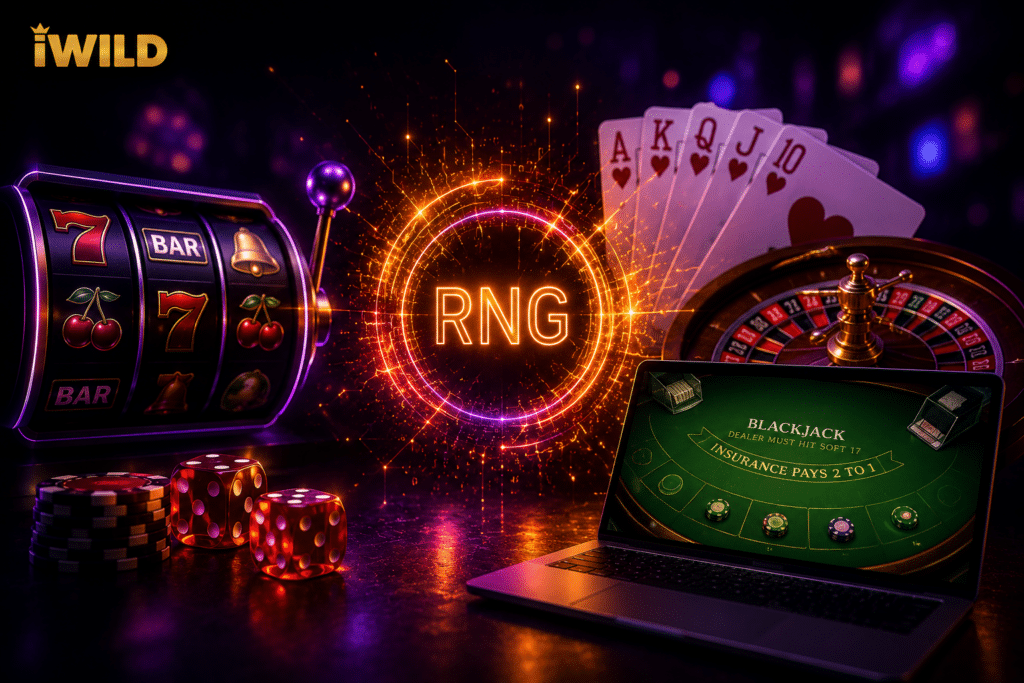
RNG determines outcomes across most digital casino games, including slots, virtual table games, video poker, and many instant-win titles.
In online slots, RNG can determine:
- Symbol positions
- Bonus triggers
- Free spin outcomes
- Jackpot eligibility
- Feature combinations
Virtual blackjack and roulette also use RNG. It can determine the order of cards, the roulette result, or other digital game events.
In video poker, the RNG decides which cards appear in the deal.
Modern casino games use RNG for far more than simply selecting a win or loss. One underlying number sequence can be mapped to multiple game elements, including symbols, features, prizes, and bonus events.
Do Live Dealer Games Use RNG Too?
Not all live dealer games are free from RNG. The important distinction is whether the core result comes from physical equipment or a digital game system.
Traditional live dealer games use physical randomness. A real dealer may shuffle cards or spin a wheel on camera, meaning no RNG determines the core result.
Newer live casino slots can combine a game-show presenter with a digital, RNG-driven outcome. These games still use RNG even though a live host appears on screen.
The simple test is:
- Real cards, wheels, or equipment operated on camera: no RNG for the core result
- Digital wheel graphics or slot reels: RNG is involved
- A live presenter with a digital game: the result may still be RNG-based
Always check the game description if the format is unclear.
RNG Certification — Who Actually Checks This?
Casinos and game developers are not expected to certify their own RNG systems. In regulated markets, independent, regulator-approved testing organisations usually verify an RNG before a game can legally launch.
Recognised certification bodies include:
- GLI, or Gaming Laboratories International
- eCOGRA
- iTech Labs
- BMM Testlabs
- TST
These organisations are independently accredited and recognised across multiple jurisdictions.
If a casino or game developer references one of these certifications, it is generally a meaningful compliance signal rather than an ordinary marketing badge.
Certification shows that an external testing body has examined the relevant system against technical and regulatory requirements. Players should still check the operator’s licence and local rules, since certification alone does not answer every question about a casino.
The Certification Process, Step by Step
RNG certification is a detailed, multi-stage process rather than a simple approval form.
The main steps usually include:
- Source code review
- The laboratory examines the actual algorithm for technical soundness and compliance with industry standards.
- Statistical analysis
- A very large sample of generated outcomes is tested for detectable patterns or irregularities that could suggest compromised randomness.
- Seed testing
- The laboratory checks whether the initial seed is generated unpredictably and cannot be easily guessed.
- Security testing
- The system is assessed for vulnerabilities that could allow hacking, manipulation, or unauthorised access.
- Ongoing re-audits
- Certified systems are checked periodically after launch rather than receiving only a single lifetime approval.
This process is designed to test both the mathematical behaviour and the security surrounding the RNG.
What Happens If a Game Isn’t Compliant?
RNG non-compliance can lead to serious regulatory action against an operator or game developer.
Possible consequences include:
- A formal warning
- Required corrective action
- Financial penalties
- Game removal
- Licence restrictions
- Full licence suspension
Serious RNG violations are rare because certification and ongoing auditing are thorough.
In the wider gambling industry, compliance issues more often involve areas such as anti-money-laundering procedures, customer verification, or responsible gambling controls than RNG integrity itself.
RNG vs RTP — Two Different Things Entirely
RNG and RTP are related, but they are fundamentally different concepts. Many players use the terms interchangeably, even though they describe separate parts of a casino game.
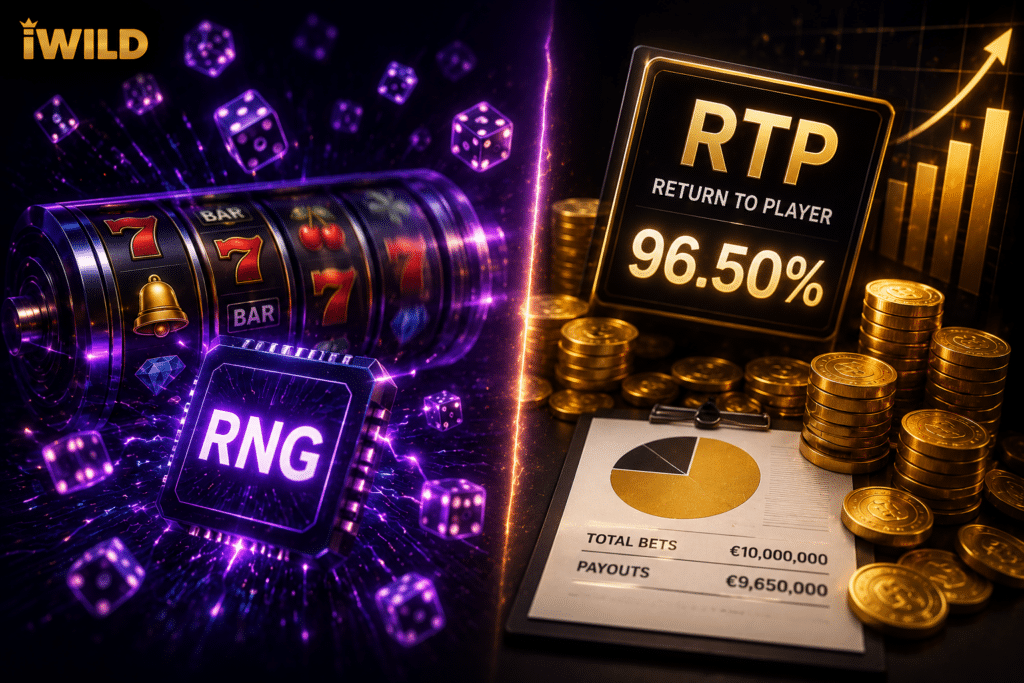
RNG is the mechanism that generates individual random outcomes. It determines what happens on a particular spin, deal, or round.
RTP, or Return to Player, is a percentage representing the average amount a game is designed to return over a very large number of plays.
Developers calculate RTP by running millions of simulated rounds during a game’s design and testing phase.
For example, a slot with a 96% RTP is theoretically designed to return $96 for every $100 wagered over an enormous sample. It does not guarantee that every player receives 96% back during one session.
Are RNGs Fair? Common Myths, Debunked
Yes, certified RNGs are fair because their outcomes are genuinely unpredictable and cannot be manipulated by the casino, developer, or player.
Despite this, several persistent myths continue to circulate about how RNGs supposedly behave.
The sections below address the most common claims directly and explain what certified RNG systems actually do.
Hot and Cold Slots — Real or Myth?
The idea of “hot” and “cold” slots has no basis in how RNG systems work.
A hot slot is supposedly paying out and therefore likely to keep winning. A cold slot is believed to be losing and supposedly due for a payout.
In reality, every spin is an independent event. It is calculated from the current RNG state, with no memory of previous results.
Ten wins or ten losses in a row can happen through probability alone. Neither sequence provides a reliable signal about what comes next.
Treating a pattern as meaningful is a common, but understandable, misunderstanding of randomness.
Can You “Beat” an RNG?
No. You cannot consistently beat a certified RNG through skill, timing, patience, or by studying visible patterns.
Certified RNGs are tested specifically to ensure that no reliable exploit exists for players, casinos, or developers.
However, a player can experience a genuine lucky streak and win a significant amount. That is variance working in their favour.
A lucky result is not the same as consistently and predictably defeating the system through strategy or observation.
The “Big Red Switch” Myth
The “big red switch” myth claims that a casino can stop a specific player from winning whenever it chooses.
No such mechanism exists in a properly certified and regulated RNG system. Certification and ongoing audits are designed to prevent exactly this type of manipulation.
A casino cannot simply activate a hidden setting to change one player’s next result.
The myth usually comes from looking for an external explanation during a frustrating losing streak, rather than from any real casino capability.
Are Live Casino Games Fairer Than RNG Games?
Watching a real dealer does not automatically make a casino game fairer than an RNG game.
Both formats can be independently tested and certified, but they are checked in different ways:
- Live games are assessed for physical equipment and dealer procedures.
- RNG games are tested for computational randomness.
- Regulated operators must follow security and integrity controls.
Once properly certified and regulated, neither format has an inherent trust advantage.
The preference is often about comfort and enjoying a visible, human-run game.
RNG and Responsible Gambling
Understanding RNG can support more responsible gambling because every spin is independent and has no memory of previous results.
This is important when players chase losses because they believe a game is “due” to win after a losing streak.
A bad run does not build up a guaranteed payout. Continuing to play does not improve the odds of the very next spin.
The same misunderstanding can make players believe that persistence will eventually make up for earlier losses.
Recognising that each result stands alone is a practical reason to pause, follow a pre-set budget, and stop when the planned session ends.
Certified vs Provably Fair — Why You Can’t Verify Standard RNG Yourself
A certified RNG relies on trust in an independent testing laboratory. The lab reviews the system, analyses its results, and may conduct ongoing audits.
However, a player cannot personally verify that a specific standard RNG spin was genuinely random. You are trusting the certification process and the operator’s continued compliance.
Provably fair systems use a different verification model. They are found mainly at crypto casinos and are commonly used for games such as crash, dice, and roulette-style titles.
Before a round begins, the system publishes a cryptographic hash connected to the result. After the round, you can use the game’s verification tool to confirm that the outcome was not changed.
Provably fair does not automatically mean more random or fairer than certified RNG. It shifts verification from an independent laboratory to the player.
That distinction matters: one model delegates testing to experts, while the other lets players check individual outcomes themselves.
Frequently asked questions
Certified casino RNGs are not rigged. Independent testing laboratories examine them specifically to prevent manipulation by any party, including the casino itself.
They also review statistical performance, source code, security controls, and ongoing compliance requirements.
Most digital casino games use RNGs to determine their outcomes. Online slots, virtual blackjack, roulette, video poker, and instant-win games commonly rely on this technology.
The notable exception is a traditional live dealer game using real cards, wheels, or other physical equipment.
Yes, RNGs directly determine every online slot outcome. They control symbol placement, bonus triggers, free spins, jackpot eligibility, and win calculations.
These results come from a random number sequence mapped to the slot’s reels, paytable, and feature rules.
Check the game’s information panel or the casino’s licensing and certification pages. Recognised references may include GLI, eCOGRA, or iTech Labs.
You can also review the game rules, software provider, RNG details, and applicable regulatory information before playing.
Independent testing laboratories assess RNGs alongside gambling regulators in each licensed jurisdiction.
Recognised organisations include GLI, eCOGRA, iTech Labs, BMM Testlabs, and TST. The testing lab examines the technology, while the relevant regulator oversees the operator’s licence and compliance.